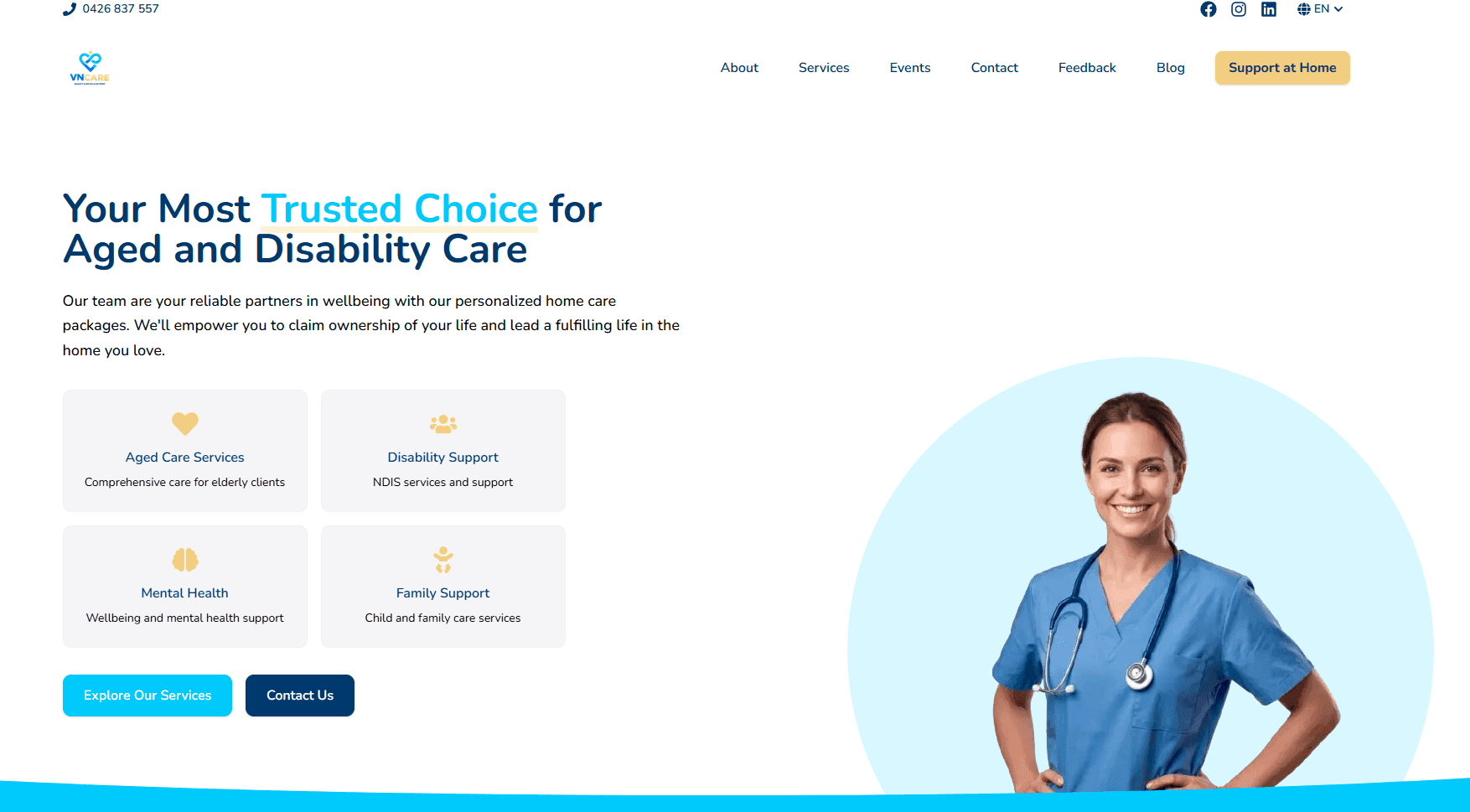
The last of the solo client sites closes the pattern. VN Care is an NDIS support-worker service, and like Exhibit F it needed a clear, trustworthy presence for participants and coordinators. Unlike Exhibit F, it also needed a back office: services change, staff come and go, content moves — and none of that could require a developer.
So the subject built two things and only one of them is visible. The public site is the familiar solo stack — Next.js and Tailwind over Supabase — plain-spoken and quick. Behind it sits a configurable CMS admin where the team manages services, staff and content themselves, without touching code. The desk observed the arrangement in operation: pages changing with no developer at the scene.
Read together with Exhibits E and F, the method is now established beyond dispute. The subject takes a client job alone, builds exactly the machinery the client can operate, and leaves. Three sites, three sets of owners running their own premises — and in Exhibit A, the same method taken as far as accounts, a live diary and a concierge that answers.
“He builds exactly the machinery the client can operate, then hands over the keys.”
The site is in production at vncare.com.au, managed day to day by its own team. The investigation declares the solo pattern proven, and directs readers with remaining doubts to the premises themselves.